Musick of Sundrie Kinds Thomas Ford
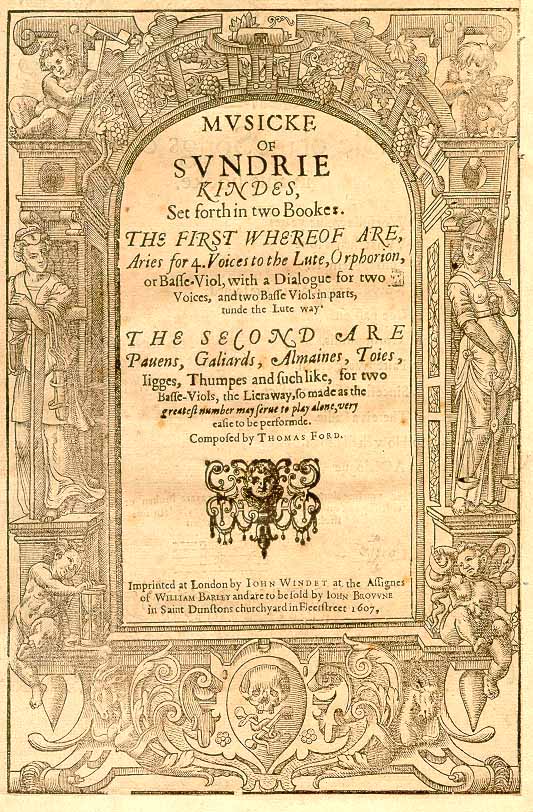
Musick of Sundrie Kinds
Imprinted at London by IOHN WINDET at the Assignes of WILLAM BARLET
London 1607
- 2026, March 19 at 19:30
- Djuke
- Ford_Sundrie_kinds.zip
- Ford_Sundrie_kinds-Songs.pdf
- Ford-titlepage.jpg
11 Sections
-
Not full twelve years
Musicke of sundrie kindes (1607), #1.
- 2/2
- half note=60 (Andante)
- F[1b]
- Cantus
- Altus
- Tenor
- Bassus
- Lute
-
What then is love?
Musicke of sundrie kindes (1607), #2.
What then is love, sings Corydon, Since Phyllida is grown so coy? A flattering glass to gaze upon, A busy jest, a serious toy, A flower still budding, never blown, A scanty dearth in fullest store Yielding least fruit where most is sown. My daily note shall be therefore — Heigh ho, chil love no more. ’Tis like a morning dewy rose Spread fairly to the sun’s arise, But when his beams he doth disclose That which then flourish’d quickly dies; It is a seld-fed dying hope, A promised bliss, a salveless sore, An aimless mark, and erring scope. My daily note shall be therefore, — Heigh ho, chil love no more. ’Tis like a lamp shining to all, Whilst in itself it doth decay; It seems to free whom it doth thrall, And lead our pathless thoughts astray. It is the spring of wintered hearts Parched by the summer’s heat before Faint hope to kindly warmth converts. My daily note shall be therefore — Heigh ho, chil love no more.
- 3/2
- quarter note=100 (Allegretto)
- C[0b]
- Cantus
- Altus
- Tenor
- Bassus
- Lute
-
Unto the temple
Musicke of sundrie kindes (1607), #3.
Unto the temple of thy beauty, And to the tomb where pity lies, I, pilgrim-clad with zeal and duty, Do offer up my heart, mine eyes. My heart, lo! in the quenchless fire, On love’s burning altar lies, Conducted thither by desire To be beauty’s sacrifice. But pity on thy sable hearse, Mine eyes the tears of sorrow shed; What though tears cannot fate reverse, Yet are they duties to the dead. O, Mistress, in thy sanctuary Why wouldst thou suffer cold disdain To use his frozen cruelty, And gentle pity to be slain? Pity that to thy beauty fled, And with thy beauty should have lived, Ah, in thy heart lies burièd, And nevermore may be revived; Yet this last favour, dear, extend, To accept these vows, these tears I shed, Duties which I thy pilgrim send, To beauty living, pity dead.
- 4/4
- quarter note=126 (Andante)
- Bb[2b]
- Cantus
- Altus
- Tenor
- Bassus
- Lute
-
Now I see thy looks were feigned Poem by Thomas Lodge Thomas Ford Musicke of sundrie kindes (1607), #4.
Now I see thy looks were feigned Poem by Thomas Lodge
Musicke of sundrie kindes (1607), #4.
Now I see thy looks were feigned, Quickly lost and quickly gained; Soft thy skin, like wool of wethers, Heart inconstant, light as feathers, Tongue untrusty, subtlesighted, Wanton will, with change delighted. Of thine eye I made my mirror; From thy beauty came my error; All thy words I counted witty; All thy sighs I deemed pity, Thy false tears that me aggrieved First of all my trust deceived. Fain'd acceptance when I asked, Lovely words with cunning masked, Holy vows but heart unholy. Wretched man, my trust was folly! Lily white and pretty winking, Solemn vows but sorry thinking. Siren pleasant, foe to reason, Cupid plague thee for thy treason! Now I see, O seemly cruel; Others warm them at my fuel. Wit shall guide me in this durance, Since in love is no assurance. Change thy pasture; take thy pleasure. Beauty is a fading treasure. Prime youth lasts not; age will follow, And make white those tresses yellow. Wrinkled face for looks delightful Shall acquaint the dame despiteful. And when time shall date thy glory, Then too late thou wilt be sorry.
- 4/4
- quarter note=118 (Andante)
- F[1b]
- Cantus
- Altus
- Tenor
- Bassus
- Lute
-
Go, passions, to the cruel fair
Musicke of sundrie kindes (1607), #5.
Go, passions, to the cruel fair. Plead my sorrows never ceasing. Tell her those smiles, those smiles are empty air, Growing hopes, but not increasing, hasting, Wasting with swift pace date of joy in dull disgrace. Urge her (but gently, I request) With breach of faith and wrack of vows. Say that my grief, my grief, and mind's unrest, Lives in the shadow of her brows, Plying, flying there to die in sad woe and misery. Importune pity at the last (pity in those eyes should hover). Recount my sighs, my sighs and torments past As annals of a constant lover, Spending, ending many days Of blasted hopes and slack delays.
- 4/4
- quarter note=126 (Andante)
- F[1b]
- Cantus
- Altus
- Tenor
- Bassus
- Lute
-
Come, Phyllis
Musicke of sundrie kindes (1607), #6.
Come, Phillis, come into these bow'rs. Here shelter is from sharpest show'rs. Cool gales of wind breathes in these shades; Danger none this place invades. Here sit, and note the chirping birds, Pleading my love, pleading my love in silent words. Come, Phillis, come; bright heaven's eye Cannot upon thy beauty pry. Glad Echo in distinguish'd voice, Naming thee, will here rejoice. Then come and hear her merry lays, Crowning thy name, crowning thy name with lasting praise.
- 4/4
- quarter note=120 (Andante)
- F[1b]
- Cantus
- Altus
- Tenor
- Bassus
- Lute
-
Fair, sweet, cruel
Musicke of sundrie kindes (1607), #7.
Fair, sweet, cruel why dost thou fly me? Why dost thou fly me? Go not, go not, oh go not from thy dearest. Though thou dost hasten, I am nie thee; When thou seem'st far, then am I nearest. Tarry then, tarry then, oh tarry, oh tarry then, And take me with you. Fie, fie, sweetest, Here is no danger, here is no danger. Fly not, fly not, oh fly not; Love pursues thee. I am no foe, nor foreign stranger. Thy scorns with fresher hope renews me.
- 4/4
- quarter note=108 (Andante)
- F[1b]
- Cantus
- Altus
- Tenor
- Bassus
- Lute
-
Since first I saw your face
Musicke of sundrie kindes (1607), #8.
Since first I saw your face, I resolv'd to honour and renown yee. If now I be disdained, I wish my heart had never known yee. What I that lov'd and you that liked Shall we begin to wrangle? No, no, no, my heart is fast And cannot disentangle. If I admire or praise you too much, That fault you may forgive me, Or if my hands had stray'd but a touch, then justly might you leave me. I ask'd you leave; you bade me love, is't now a time to chide me? No, no, no, I'll love you still, What fortune e'er betide me. The sun, whose beams most glorious are, Rejecteth no beholder, And your sweet beauty past compare, Made my poor eyes the boldder. Where beauty moves and wit delights, And signs of kindness bind me, There, O there, wheree'er I go, I'll leave my heart behind me.
- 4/4
- quarter note=120 (Andante)
- C[0b]
- Cantus
- Altus
- Tenor
- Bassus
- Lute
-
There is a lady, sweet and kind
Musicke of sundrie kindes (1607), #9.
There is a lady sweet and kind, Was never face so pleas'd my mind, I did but see her passing by, And yet I love her till I die. Her gesture, motion and her smiles, Her wit, her voice, my heart beguiles, Beguiles my heart, I know not why, And yet I love her till I die. Her free behavvior, winning looks, Will make a Lawyer burn his books, I touch'd her not, alas not I, And yet I love her till I die. Had I her fast betwixt mine arms, Judge you that think such sports were harms, Wert any harm? No, no, fie, fie, For I will love her till I die. Should I remain confined there, So long as Phoebus in his sphere, I to request, she to deny, Yet would I love her till I die. Cupid is winged and doth range Her country so my love doth change; But change she earth or change she sky, Yet will I love her till I die.
- 4/2
- quarter note=120 (Andante)
- C[0b]
- Cantus
- Altus
- Tenor
- Bassus
- Lute
-
How shall I then describe
Musicke of sundrie kindes (1607), #10.
Now shall I then describe my love? When all men's skillfull art Is far inferior to her worth, To praise the unworthiest part. She's chaste in looks, mild in her speech, In actions all discreet, Of nature loving, pleaing most, in virtue all complete. And for her voice a Philome; her lip may all lips scorn. No sun more clear than is her eye in brightest summer morn, a mind wherein all virtues rest and takes delight to be, and where all virtues graft themselves in that most fruitful tree. A tree that India doth not yield, nor ever yet was seen, Where buds of virtue always springs, and all the year grows green. That country's bless'd wherein she grows, and happy is that rock From whence she springs, but happiest he that grafts in such a stock.
- 4/4
- quarter note=120 (Andante)
- C[0b]
- Cantus
- Altus
- Tenor
- Bassus
- Lute
-
A dialogue: Shut not, sweet breast
Musicke of sundrie kindes (1607), #11.
- 4/2
- half note=87 (Andante)
- F[1b]
- Cantus 1
- Lute 1
- Cantus 2
- Lute 2